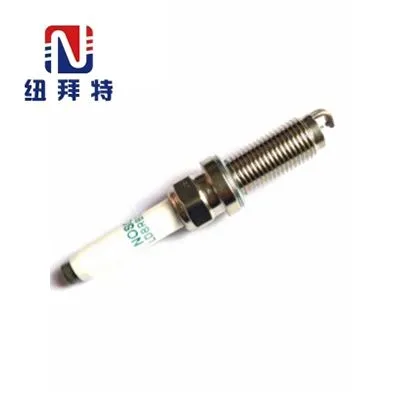
Automobile Spark Plug Product Functions
Jan 07, 2024
There are spark plugs on most gasoline engines, one for each cylinder. Some high-speed gasoline engines are also equipped with 2 spark plugs per cylinder. Although the spark plug is a small part, it is extremely important. Without it, the engine will not move. Anyone who drives a car regularly will be familiar with this thing.
The function of the spark plug is to introduce high-voltage electricity (more than 10,000 volts) generated by the ignition coil into the engine cylinder, and generate sparks between the gaps of the spark plug electrodes to ignite the mixture. The working environment of spark plugs is extremely harsh. Taking the spark plug of an ordinary four-stroke gasoline engine as an example, the temperature during the intake stroke is only 60°C and the pressure is 90KPa; during ignition and combustion, the temperature will instantly rise to 3000°C and the pressure will reach 4000KPa; This alternating frequency of rapid cooling and rapid heating is very high, which cannot be handled by ordinary materials. Insulation performance must also be ensured, so the material requirements for spark plugs are also very strict.
The spark plug is small, but its construction is not simple. It has two major components: an insulator and a metal shell: the metal shell is threaded for screwing into the cylinder; an insulator is installed inside the shell, and a center electrode runs through it. There is a wiring nut on the upper end of the center electrode, which is connected from High-voltage wires coming from the distribution board; a ground electrode is welded to the lower end of the casing. There is a gap of 0.6-1.0 mm between the center electrode and the ground electrode. When the high-voltage electricity passes through this gap and enters the ground, sparks will burst out to ignite the mixture. .
The key part of the spark plug is the insulator. If the insulator does not work, the high-voltage electricity will "take a small path" and not go to the ground through the two poles, resulting in no spark. The insulator of the spark plug must have good mechanical properties and the ability to withstand high voltage, high temperature impact, and chemical corrosion. Ordinary spark plugs are mostly made of ceramics based on alumina. The size of spark plugs is uniform around the world and can be used in any car. However, due to differences in gasoline engine types, spark plugs are also divided into two basic types, cold type and hot type. The cold type is relative to the hot type, which reflects the thermal characteristics of the spark plug. The spark plug must have the appropriate temperature to work well, and there must be no carbon deposits to work properly. Practice has proved that when the spark plug insulator is kept at a temperature of 500-600°C, the oil droplets falling on the insulator can be burned immediately without forming carbon deposits. If the temperature is higher than this temperature, it will ignite prematurely, and if the temperature is lower than this temperature, there will be carbon deposits. The temperature on different engines will be different, and designers use the length of the insulator skirt to solve this contradiction. Some skirts are short and have a small heating area and fast heat dissipation, so the temperature of the skirt is lower. They are called cold spark plugs and are suitable for high-power engines with high speed and high compression ratio. Some skirts are slender and have a large heating area and slow heat dissipation, so the skirts are If the temperature is higher, it is called a hot spark plug, which is suitable for low-power engines with medium to low speed and low compression ratio. Which spark plugs to use in your car should be selected according to the manufacturer's specifications. Not all spark plugs are suitable.
The spark plug looks simple, but is not easy to make. It has very high requirements on materials and manufacturing processes. Due to the very harsh working environment, spark plug insulator breakdown and electrode carbon deposition failure often occur, so it is a "consumable part" "Many drivers keep spark plugs in their toolbox so they can be replaced at any time. Of course, with the development of technology, the durability of spark plugs has also improved. The electrode material uses platinum alloy instead of the traditional copper-nickel alloy, which extends the service life of the spark plug. The spark plugs of modern cars generally have a mileage of about 50,000 kilometers.
There are many factors to consider when choosing spark plugs, such as engine model, cooling method, number of strokes, fuel label, ambient temperature and common working conditions. Generally, the spark plug model of motorcycles and cars has been determined when leaving the factory. If the installation dimensions match, the user can choose the calorific value of the spark plug based on the ambient temperature, road conditions, and the age of the machine. For example, the calorific value model generally used under the standard conditions of domestic spark plugs is 6. When the temperature is lower than 5°C, a spark plug with a lower calorific value should be selected to ensure the working temperature of the spark plug skirt. For old engines, choosing a spark plug with a lower calorific value can resist the contamination of the spark plug by oil leakage due to wear and tear of the machine parts.
Many times, it is difficult to start a car when the engine is cold or hot. Sometimes it takes multiple starts before the engine can start the car. After starting the car, the idling is unstable, jittering, poor acceleration, insufficient power, frequent idling self- stalling, and increased fuel and gas consumption. This is caused by a damaged spark plug.
A fault check should be carried out first. After cleaning the throttle valve, replacing spark plugs and high-voltage wires, the fault did not improve, and became more obvious when the air conditioner was turned on. Connect the oil pressure gauge and test. When idling and stalling, the oil pressure remains at 260 kPa, indicating that the oil supply is normal. Use the cylinder cutoff method to check the ignition and working status of each cylinder. Remove the high-voltage wire of the first cylinder and use a good spark plug. When doing the flashover test, the engine vibrated but did not stall; when the high-voltage wires of the 2nd, 3rd, and 4th cylinders were removed for the flashover test, the engine was difficult to start, and would automatically stall even if it started occasionally. From this, it is determined that the spark plug of cylinder 1 is not working properly.
Next, perform troubleshooting. After replacing the new spark plug of the first cylinder, the fault is completely eliminated.
Finally, a fault analysis was conducted and the ignition system information of this model was verified: This vehicle adopts a modular, distributor-less, dual-spark static high-voltage distribution ignition system. There are 2 ignition coils in the static high-voltage distribution body, and each ignition coil is Each stage has 2 output terminals, which are connected to the spark plugs of each cylinder through high-voltage wires to form dual ignition circuits. When the ignition coil ignites normally, if the gap between the two spark plugs is normal and the cylinder doing the work is at the top dead center of compression, after the combustible mixture is compressed, the impedance formed between the spark plug electrodes is small and is prone to breakdown and flashover, and the ignition power It will be concentrated on the spark plug of the power cylinder and flash over; while the other cylinder is relatively at the exhaust top dead center, the gas in the cylinder has a large resistance and is not easy to be broken down and flash over, thus ensuring the normal ignition of the power cylinder. . When a spark plug has a short circuit, the breakdown voltage of the spark plug decreases, and most of the electric energy is lost through the faulty spark plug, causing the other cylinder to be unable to ignite normally, causing both cylinders to malfunction and the engine to be difficult to start; and when a spark plug When there is an open circuit, because the breakdown voltage of the spark plug is too high, the ignition energy is flashed through the normal spark plug, so the other relative cylinder can still ignite normally. Three cylinders of the engine can work normally, so the stability and power Very poor.